Our High Risk Pregnancy So Far: Why We’ve Accepted Induction Of Labour

The last few weeks have been stressful with no news and, as a result, no plan. Finally, at 36 weeks, we now have one, but it might not be the plan everyone was expecting us to have. If you haven’t read our previous post about our pregnancy journey so far, you can read the last one here

From the start, we always knew that I’d require some sort of medical input when it came to labour time and birth. Our biggest fears were that I’d be pressured into accepting a c-section which for me would mean a difficult recovery and relying on Alex and our families for almost everything for the first 8-12 weeks, both in terms of my care and little one’s. I’ve always been for a physiological birth, or as close to it as I can possibly get, only going for a c-section or other interventions if absolutely necessary, especially as it would very likely need to be done under general. Luckily, the result of the MDT meeting was that if I don’t want an elective c-section, then I don’t have to have one, but it’s under the condition that I’m aware we could still be heading down that route if either little one or I don’t cope well in during labour. 

How the option of induction came about and why we accepted

One of the biggest things about not going down the c-section route is unpredictability and the risks involved. For us, not only do I have a medical condition which means I can’t feel movements or contractions and have to palpate for them, but I’m also at risk of precipitous labour. Then, to top it off, we found out that I have Group B Strep at 26 weeks, and I’m also at risk of other complications. It meant that the idea of induction was proposed to us, with all the risks and benefits involved. Benefits? We’d have an idea of when my labour will begin, and with it, the option to ensure Alex is off work for a few days so that he doesn’t miss the birth. It also eliminates the risk of me giving birth at home with no help other than Alex’s Avmed training, which, whilst the scope of what Avmed covers is fantastic, where childbirth is concerned, it doesn’t equip you for a complicated labour birth. Cons? If it fails or something else happens, it’s a c-section since assisted delivery via forceps or ventose is out of the question due to dislocation risk. It also further increases my haemorrhage risk, something my consultant already factored in early on so that there’ll be medication drawn up and on standby if it’s needed. 

As my midwife talked to me about induction some weeks ago when Alex’s roster and being back at work was causing me stress around whether or not he’d even make the birth, Alex and I had actually spoken about the possibility of induction. We researched the risks and benefits before my consultant had even offered it to us to come to a decision together without feeling pressured. After those discussions with Alex and my midwife, I said that if induction was offered to me, I’d accept it to reduce the risk of that happening as him not being at the birth would be heartbreaking for us both. It also gives us some control over the situation as long as little one stays put and I don’t go into labour before induction day, something which could happen and my consultant warned us about when we accepted the offer. Alex had already made it clear that he’s scared of waking up during the night to find me still asleep whilst in advanced labour, something which we both know would affect him massively even with all of the training he’s equipped with, thanks to him being crew! 

As you can see, accepting an induction of labour was an easy decision for us once we’d weighed up all of the risks and benefits. Even with the risk of having to go down the c-section route if something goes wrong, the thought of having an unattended labour and birth with all of the dangers attached due to my complex medical history scares Alex and I more. We are also fortunate that we never felt pressured by the team looking after us to accept induction, mainly because we’d had that discussion ourselves beforehand, giving us time to fully consider everything. Not only is there information on induction of labour available to read in my handheld notes, but we also turned to Google to research the specific risks that are unique to our situation and spoke to other pregnant people who have EDS. But what if you’re enjoying a lower risk pregnancy and offered induction, or just don’t know if you want one?

Research is your best friend

Alex and I both know people who have been offered induction of labour and felt little pressure to accept, as well as plenty of people with low-risk pregnancies who felt forced into accepting an induction to keep their team happy. We started looking into our options quite early on once our consultant told me that she’d do everything possible to keep our options for labour and mode of delivery open. That kind of support from her when every other specialist outside of obstetrics had told me that c-section was the safest way forward meant the world to both of us. It also meant that we felt even more supported by the teams looking after us, both at our local hospital and the Silver Start Unit in Oxford, who we’re so thankful to have the specialist input of. 

Great places to research induction include Google (especially as you can tailor your search to your unique situation) and your handheld notes if your hospital provides information on induction of labour in these. I also highly recommend speaking to people who’ve had an induction of labour offered about their experiences, even if they didn’t accept the offer, as firsthand experiences can often help the decision making process. This same piece of advice goes for those who have medical conditions which could influence management. There are plenty of online groups on Facebook etc., which allow you to connect with others going through similar! If you can, start researching and discussing your thoughts with someone else early! This means by the time an offer of induction is given to you (if it is), you’ll have already thought about it and either decided on whether or not to accept, or you’ll have an idea of what questions to ask. It also means that whatever your decision is, you’ll be able to explain the reasoning behind your decision to whoever is looking after you knowing that you’ve given yourself time to consider all the risks and benefits. I’ve also learned to use one acronym that has helped us massively with each decision we make, called B.R.A.I.N. 

What is B.R.A.I.N?

B.R.A.I.N really is what it says it is; it’s using your brain to make an informed decision. 

B – Benefits (what are the benefits of this test or procedure for me and my baby?) 

R – Risks (what are the risks of this test or procedure for me and my baby?)

A – Alternatives (What, if any, are the alternatives?) 

I – Instinct (What is my instinct telling me? What do I think and feel about this test or procedure? Who else can I ask about it?)

N – Nothing (What could happen if I decide to do nothing or wait and see? Can this test or procedure be delayed? Can I take some time to think about it or research?)

B.R.A.I.N is something we’ve used throughout our pregnancy journey to make informed decisions and choices that we know are right for us without feeling pressured into doing something we may not necessarily want to do. It’s also something that we will continue to use and advocate that others use, especially as it is such a handy tool to have. With the NICE draft guidelines meaning that an increasing amount of people are already being offered induction at 39 weeks even if there isn’t a clear clinical need, now more than ever, birthing people and their partners must be able to make informed decisions without feeling pressured into accepting something they may not actually want. 

Have you been offered an induction of labour or had one in the past? Feel free to share your experiences in the comments with us! 
Accessibility When Pregnant: A Disabled Parent-To-Be’s Point Of View

Being pregnant and disabled seems to throw near enough everyone. If it’s not people making assumptions and comments related to becoming a disabled parent (see our blog post on that here), it’s the lack of access to maternity care. Society can’t get to grips with the simple fact that disabled people have lives, have relationships, create families, and need the same access to services as able-bodied people!

Healthcare settings, in general, are not the most accessible places for disabled people. For example, wheelchair users requiring cervical or other screenings often can’t get onto the beds or close to the machines and sometimes can’t even get into the room they need to go in. In addition, sighted guidance training doesn’t always seem to have been provided to staff, and thanks to Covid-19, masks mean that those who rely on lip-reading are often left not knowing what’s going on. This is just the tip of the iceberg of access problems.

For me, in maternity specifically, the access issues have recently become a nightmare. Whilst the antenatal clinic is relatively accessible at my local hospital for wheelchair users, the same cannot be said for labour triage upstairs! Right from the beginning, my midwife has made as many of my appointments as possible with her home visits. Not just because of my vulnerability status regarding Covid-19, but because my home is set up for me. I can transfer out of my chair onto the sofa or the bed when it’s time to check little one’s positioning and listen to their heartbeat, and I also feel much more at ease because hospitals and I have a pretty bad history.

At my local hospital, labour triage has two assessment rooms. Both rooms are so small that as a wheelchair user, I’m unable to move around in either. It also means I can’t transfer onto the bed on a good day, can’t be hoisted in these rooms on a bad day, and to top it off, if I need monitoring, then it’s done with me sitting in my wheelchair, which can mean that the CTG doesn’t always meet criteria. If I need other examinations for whatever reason, the only option available is to wait for one of the larger delivery rooms to free up. The problems don’t stop there either, as in labour triage there’s no disabled toilet. It’s a case of me making sure I take a urine sample in with me when I go in, or I have to go downstairs to the disabled toilet to do one. It also means that if I need to catheterise whilst upstairs, we then have to go downstairs to do that. So far, in the few visits that I’ve had for various scares, I’ve found two delivery rooms that have toilets I can use as they have grab rails in, although on one of these I’ll still need help to transfer as the grab rails aren’t on both sides.

My access needs have become a bigger worry as the delivery day nears. Will I end up being a burden on already overstretched staff when I need help in the times Alex or other family coming to visit us aren’t there? I’ve already been made to feel like a burden once when a registrar didn’t understand my needs. If it wasn’t for the fact that my own midwife was with me when it happened, I probably would have broken down even more than I did. At 33 weeks, when we were worried I may have gone into preterm labour, I was seen in one of those tiny triage rooms. The registrar was adamant that they could help me onto a bed that both my midwife and I knew I wouldn’t be able to safely get on without being hoisted. In the end, my lovely midwife said to me, ‘I’m going to go and speak with the others to get you into one of the delivery rooms because there’s no way we’re risking a dislocation!’ Having that kind of advocacy during one of my most vulnerable moments has been invaluable.

The lack of access around the hospital is such a worry that I’m dreading the postnatal period whilst in hospital. Will there be enough room around the bed for my chair and my case, especially with little one’s cot to contend with as well. Will I be able to use the bathrooms and toilet on the postnatal ward? If I need to be hoisted, will there be room for that? Thankfully, I have such a great midwife that she’s already thinking ahead to that period, even to the point of planning to ask for me to have a side room which will mean more space. Anyone who’s given birth in a hospital knows that side rooms on postnatal are a rarity, so if we do manage to get one, I’ll be even happier. With my medication having a sedative effect, I know that it’s going to be a tough ask, but my access needs are just as important as other needs in the bigger picture.

Many won’t realise this, but July marks Disability Pride month. If you didn’t know that, it’s likely because you haven’t seen the equivalent of rainbow washing that companies perform during Pride month in June. You see, companies don’t seem to bother with disabled folk; I’ve seen hardly any talk about how they’re helping disabled people or making their services more accessible. Our communities’ struggles aren’t for one month of the year, they are every single day, and that’s why active allyship and advocacy for disabled people and their needs is so important! As I’ve said in this post, how my midwife advocates for my needs is invaluable. Not only to me but to Alex as well because he is also worried about my needs not being met if he’s not with me in hospital for whatever reason. After little one has arrived, I’ll be doing a post about how having almost one-to-one care throughout the pregnancy has really helped me and why I believe everyone should have access to that level of support if they need it!

Our High-Risk Pregnancy So Far: 32 Weeks And Still No Plan!

If there were a list of posts that we hoped we wouldn’t be doing, this is one of them! I knew from the start that pregnancy wouldn’t be easy. Alex and I spoke about that fact in detail quite a few times, as well as about what we would do in set situations, but we never thought we’d get to a point where we have no plan so soon to little one’s arrival! 

Going through a high-risk pregnancy takes its toll, and with ours, we have another problem; high levels of uncertainty. Uncertainty around labour because I can’t feel movements (more on that subject here), uncertainty and worries around neonatal withdrawal and how my medication has impacted little one, and finally, uncertainty over whether or not my body will cope with physiological birth. The latter could be true for anyone. After all, no one knows for sure if they’ll get the birth experience they dream of, but we quietly hope that everything will go to plan and for our preferences to be fully respected and carried out without question. 

For me, I’ve been adamant from the beginning that when it comes to mode of delivery, I want a physiological birth if at all possible. So when I attended my first appointments with obstetrics and my midwife, I made a point of telling healthcare professionals that I want to try, even with the uncertainty around my body being able to cope. Here’s the thing with my EDS; it’s unpredictable, especially as my dislocations can happen at any given moment. I also have autonomic dysfunction, spinal involvement, and on top of that, we don’t know for sure what type of EDS I have. Although I found out in 2015 that I have EDS, until 2019, everyone assumed it was the hypermobile type. But when my thumb joints failed to the point of needing fusion and other symptoms began popping up, there were concerns that I have classic EDS and not the hypermobile type. So when I fell pregnant again and got referred to Silver Star in Oxford, doctors there decided to get me tested and find out once and for all if it is indeed classic EDS. This very bit of information will be the difference between me getting my way and getting the chance to have a physiological birth or having to go down the c-section route. 

Up until 26 weeks, the obstetric teams I’m under all agreed to keep an open mind. However, a swab I had done when I started spotting again picked up Group B Strep. It’s not an issue during pregnancy, but it’s a problem in labour or if waters go since you need to be on antibiotics as soon as possible to reduce the risk of passing the infection onto baby. It’s yet another complication we could have done without, as it’s further heightened both mine and Alex’s anxiety around labour and birth. It’s also left me worrying that even if I can have a ‘normal’ delivery, physiological birth could out of the question if the team eventually recommend that I have an induction. 

Why The Idea Of A C-Section Scares Me 

Let me start by saying that you have to do what is best for you and your baby, and no two birth experiences will ever be the same. For birthing people who choose to go down the c-section route, I fully respect your decision and know that it isn’t always easy to make. 

For me, many of the worries around c-section delivery are linked to past medical trauma, which I’m still working on processing. My EDS means that both local and regional anaesthetics are ineffective to the point that I’ve had to be put under general for surgeries where most could be awake. In one surgery last year, I had a failed regional, and my last memory before being put under was screaming in pain as the anaesthetic failed to numb my arm. I also had problems coming around from the general afterwards, which wasn’t ideal. Luckily, we’ve been able to speak to the lead obstetric anaesthetist at the hospital in-depth about this and other issues, including my long list of allergies! During our conversation, the anaesthetist we spoke to joked, ‘you’re not an anaesthetist’s best friend, are you?’ ‘No, I’m not, I’m a paperwork nightmare’ was my light-hearted reply. That conversation also highlighted other issues. However, we also had our minds put at rest over certain things. 

One of the other worries about having a c-section under general is that we were both put under the impression Alex would not be allowed into theatre for the birth. Usually, this is the case and was so even before covid. But we’ve been reassured that depending on who is the team on the day, Alex’s emotional state (good thing he’s crew) and that there are no emergencies involving myself or little one, he may be allowed into theatre for the birth. It’s something Alex is super happy about, and I’m just relieved over even if it isn’t for certain. Having my birth partner with me means having someone I know and fully trust to fight my corner and ensure my birth preferences are respected. This is especially true where delayed cord clamping and skin-to-skin contact are concerned (both of which I want regardless of delivery method). 

There’s also the worries around my recovery from a c-section. People forget that it’s major surgery with a lengthy recovery period! In my case, it means not being able to transfer myself for 6-8 weeks which means I’ll probably need to be on hoist transfers – something I heavily detest! A c-section recovery would also mean heavily relying on Alex, my dad and others since I’ll likely have to restrict how much time I can be in my wheelchair and up and about. I also take longer to heal, thanks to my EDS, so there’s the risk that the usual restrictions could last even longer. All of this makes me worry about how much I’ll be able to be involved in our baby’s care in those first weeks.

32 Weeks and still no plan

When I had my genetic blood panel done to find out what we’re dealing with in terms of my EDS, I was informed that the results would be the most significant determinating factor regarding what mode of delivery would eventually be recommended. There was hope we’d have them back at around 28-30 weeks, enabling us to get a plan in place and know what to expect. We also need to have an MDT meeting, where all the specialists involved in both mine and little ones care meet to discuss the way forward. However, we can’t have the meeting until the genetics are back, something that is starting to worry not just Alex and I, but my consultant, who is now chasing them up. 

We’re hopeful that by 34 weeks, we’ll have the results, the meeting and know what will happen. However, I feel disheartened and stuck in limbo. My birth preferences still aren’t complete because I don’t feel I can fully finish that off until we know what is going on. As we get further along, the possibility of going into preterm labour without a clear plan is not only becoming more likely as the days go by, it’s becoming more and more worrying! However, the biggest thing for me is that whilst there’s no plan in place, I’m holding out hope I’ll get the physiological birth I’m hoping for, even if others think that option is fading away.  

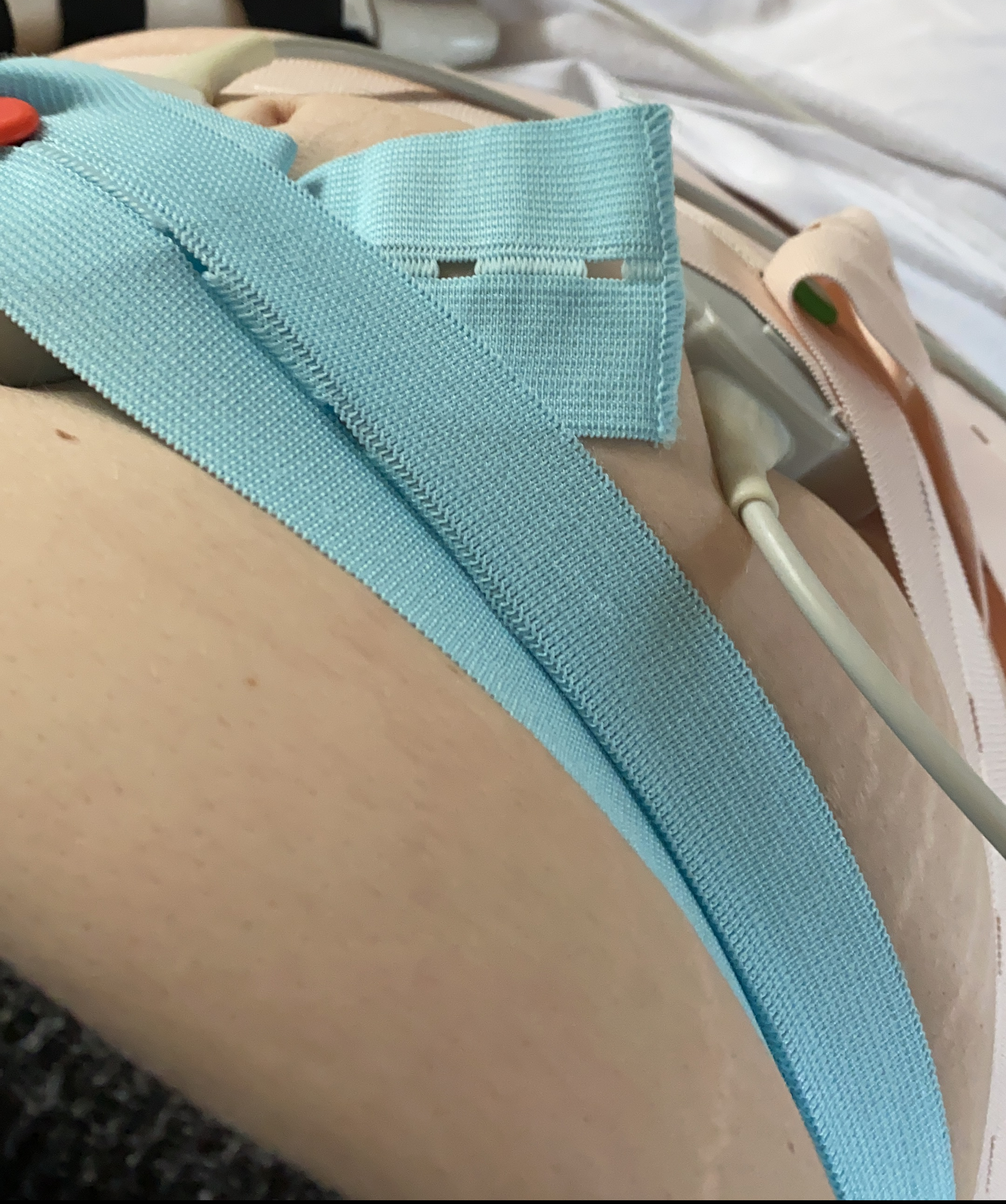
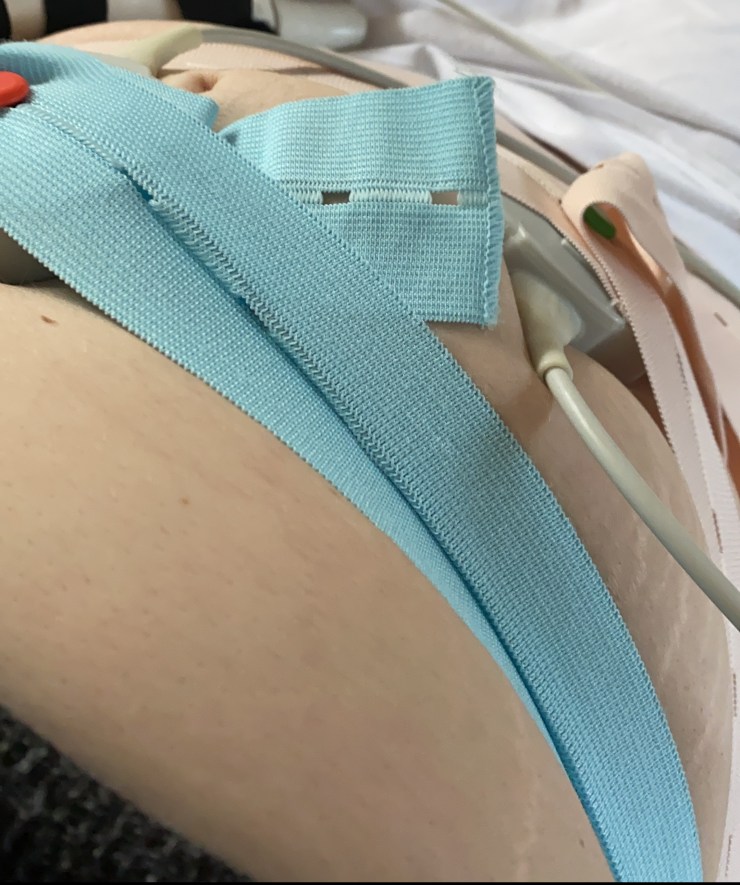
Photo of a white pregnant persons midriff, with blue and pink elastic bands holding 2 grey discs to the stomach area with grey colour wires going off to the right of the photo.

Our High Risk Pregnancy So Far: Movement Worries!

Firstly, this would have been a post about how things have changed between weeks 20 to 25, but that one will have to wait for a bit as one particular matter kept overtaking the majority of the post whilst I was writing – movements! 

To help people understand why I feel the way I do, we first have to talk about both how and why we track little one’s movements is a little bit unconventional. My condition means that from the top of my belly button down, I have no sensation and can’t feel fetal movements. The fact is that so far, the only time I’ve been able to ‘feel’ was last week when little one took one good swipe at my ribs and dislocated two of them! Because of my condition, Alex was the first to feel little one’s movements, and it’s something I’m super jealous over as it’s usually the person who’s carrying that gets to feel movements for a few weeks before anyone else can! 

So instead of going about my day whilst tracking them, my life has revolved around putting my hands on my stomach (Alex often joins in at home to cover more ground) every 90 minutes for 10-15 minutes each time since the day Alex felt bumps first movement. So essentially, we’re palpating for little one’s activity and seeing what they’re up to in there! It’s something I knew we’d have to do, but nothing could have prepared me for how complex tracking movements via this method can be since it’s only giving us a snippet of their routine. So imagine the panic we go through each time we don’t get anything when we are palpating. 

Reduced movements

The one thing that is drummed into you when you’re pregnant is to track movements, that they are how you know your little one is well, and that episodes of reduced movements should be reported to your hospital. Of course, there are plenty of varying opinions on how much activity is normal, but only you know your little ones routine.

For most, spotting reduced movements is pretty easy but for us, only being able to feel movements by palpating them means that it’s challenging to decide when to pick up the phone. My first episode happened just shy of 24 weeks, so I phoned my midwife, who quickly decided a trip up to the hospital was needed. Since then, I’ve had four more episodes of reduced movement, three of those being in the last week. The difficulty in knowing when to phone about movements is made more challenging, especially as when I’ve asked about when Alex and I should be worrying, none of those I’ve asked has a concrete answer, and the difficulties in monitoring don’t end there. 

CTG Nightmares

Photo of a white pregnant persons midriff, with blue and pink elastic bands holding 2 grey discs to the stomach area with grey colour wires going off to the right of the photo.
All hooked up to the CTG monitor

Anyone who’s had a CTG or knows what one is will probably know that there are set criteria you have to meet for the monitor to return a normal result. Unfortunately, it can be tricky for a CTG to produce a normal result between 26 and 28 weeks, from what various doctors have told us. However, my condition makes it even more likely for monitorings not to meet the criteria.

Firstly, having to palpate for movements is difficult when the monitors are one your tum! But it’s the only way I can feel movement, and when I do, taking my hand off to press the button linked up to the machine often interferes with the monitoring to the point that we’ve had a loss of contact on some occasions. 

Secondly, my heart rate tends to run high – something that not only does the monitor not like, but it’s resulted in the monitor thinking that it’s picking up little one when it’s my heart rate that it’s picked up. It’s often picked up pretty quickly, but when little one shifts away, the monitoring ends up picking up my heart rate again, which means a lot of moving the monitoring plates around! 

Not meeting criteria always means having to see the doctors before we can go home, and visits during pregnancy have become so regular that I’m on first name terms with half of them, especially as there were many hospital trips at the height of my battle with hyperemesis gravidarum. The silver lining is that my history doesn’t need to be explained as they already know about me, but it gets to a point where it starts to run you down, and no amount of people telling you it’s ok to be worried can stop you from feeling like you’re becoming a nuisance. 

Feeling like a nuisance

Even if it shouldn’t, going back and forth to the hospital for the same thing gets me down. But, luckily, most of the staff are extremely understanding of the rather unique situation I’m in, even if it’s not something that they come across on a day-to-day basis which I feel lucky for because I know that’s not the same for everyone.

However, there’s been one time where I have felt dismayed by the response I received when I told one of the midwives how I have to palpate for movement. Not only were they confused on the phone, but they also continued to be either confused at or not able to accept the fact that because I have no sensation from the top of my belly button down, I’m unable to feel movements when I was at the hospital. It wasn’t until the doctors saw me that they changed their attitude and realised that I was serious about how my condition affects my ability to track little one. 

Thankfully, since that incident, I haven’t felt disbelieved, but it’s left me feeling like a nuisance even more than I would’ve felt. I even said to one midwife in day assessment that I’m hoping my consultant can organise a plan of action regarding movements. I know the almost daily hospital visits to be monitored if little one gets into a position that makes it impossible to palpate will wear me down further and cause more stress. After all, the ongoing problems with tracking movement almost constantly remind me that I’m in a very different situation to most pregnant people. 

Five Items We’ve Discovered That Will Be A Lifesaver When Little One Arrives

No matter what anyone says, planning for your baby’s arrival is a tough job! There are so many products out there, and everyone has their own opinion of what you do (and don’t) need. For me, there are more products on the market that are entirely unsuitable for our needs than those which are. However, there are 5 items we’ve found which, for us, will be a lifesaver when the little one arrives and may even be helpful for you!

  1. Snugglebundl blanket

If there’s one thing I’ve been worried about, it’s transferring our little one without disturbing them once they’re here. Anyone who’s ever tried to move a newborn will know they wake up the second you do it, which is precisely what the Snugglebundl aims to eliminate! This genius swaddle blanket comes with handles to make it easier to lift your little one without disturbing them. You can use this blanket to transfer them from car seat to carrycot or pushchair whilst out and about (the blanket is crash-tested), or as a hammock to rock them in and to keep them securely wrapped up and warm. It’s a great thing to have on hand if recovering from a c-section or other post-birth difficulties. However, as a disabled mum who has frequent joint dislocations, the Snugglebundl is something I’ve realised that I need regardless of what birth I end up having. The Snugglebundl will be getting used from day one to pick our little one up and move them about when needed, especially as it’s specifically designed to reduce the strain on the body from all the picking up!

2. Ergobaby Omni 360 Baby Carrier

Until we found out about this baby carrier during a virtual baby show, I was worried over whether or not we’d ever find a suitable baby carrier for both Alex and I to use with our little one. We already know that there will be days where I won’t have the energy or strength to push both myself and little one in their pushchair, and not all situations will be suitable for taking the pushchair with us. Alex also prefers the idea of carrying little one instead of using the pushchair. We’ll also be travelling a lot, which means a baby carrier has become a necessity. The problem with most baby carriers, though, is that they don’t provide enough support for my joints, or worse, not even being able to get it on myself!

The Ergobaby Omni 360 isn’t only great in that you can both forward and rear face in the carrier, making it suitable for toddlers and babies alike, but you can also back as well as side carry in it. The Omni 360 also has lumbar support for the person carrying little one and a lot of padding on the straps for even more comfort, something important to both Alex and I as we’ll be using it for prolonged periods when travelling with little one. The carrier is that good ergonomically that it has been classed as a hip-healthy product. The carrier also comes in a mesh material option, something we chose over the cotton option as we know it will be heavily used in warmer climates. Another plus is that if you’re one for going on days out, the carrier also has a detachable pouch for storing things like your keys, money, and phone. The carrier also has a privacy hood with UV protection, and you’re able to breast/chestfeed without needing to remove little one from the carrier too!

3. Changing backpack With built-in cot and phone charger

Continuing on with accessories for when out and about or travelling, changing bags are of course a must. However, most of them look too mumsy and obvious, whereas I wanted a changing bag which both Alex and I could use, and could also go on the back of my chair if I’m the one carrying little one. So a quick search for changing backpacks on Amazon led to me finding this absolute beauty. I’d seen one similar on Instagram in an advert but didn’t like the cost of it, so to see this one on Amazon made me very happy. Not only does it have a big main compartment for a change of clothes, snacks etc. It also has a bottle pocket that can store three bottles, a phone charging port (need your own battery pack) and a pocket for baby wipes! The most significant function for me, however, is the inbuilt cot and changing mat. Not only does it mean we can change little one with privacy if out and about somewhere without changing facilities, but they can also nap in it when travelling during the day, or have a safe play area when travelling as well. The cot also features a sun canopy for protection on sunnier days or as a barrier against the wind if using it when outside. It’s important to note that the inbuilt cot isn’t suitable for overnight sleeping, however, so you’d still need a travel cot if going away. However, I still think it’s a great bag, and the dimensions of it when the cot isn’t in use means that if you’re flying with little one, the bag will go under the seat in front of you.

4. Benbat Portable Booster Seat

For me, the highchair situation has been one of the most stressful things to tick off because they just feel impossible to use, especially as I’m a wheelchair user who is unable to weight bear. However, there is another option which if Alex didn’t know existed, I would’ve never have found out about it! A portable booster seat has similar functions to a highchair but is lightweight, great for travel so you can feed little one anywhere, and can be placed wherever it’s needed. The one we’ve found is from Benbat, and whilst it won’t be suitable until little one can sit unaided, it will be an absolute lifesaver once they can use it. Another thing I like about the Benbat is that not only is it portable, it also comes with storage compartments to pop some of little one’s bits and bobs in. This is great, as you can forgo the changing bag and pop a change into the storage compartment of the booster seat instead if going out locally.

5. Elvie Catch

If you are breast/chestfeeding or expressing milk, suffer from leakage, and don’t want to spend loads on disposable pads or lose milk that’s produced, then the Elvie Catch is an excellent investment. Not only are these collection cups good for catching let-down or leaks from the other side when pumping, but the Catch is also wearable and slip-proof, meaning that you can wear them for up to three hours at a time without worrying about any leaks. In addition, each cup can collect up to 30ml of milk and is easy to clean by hand or dishwasher. I’ve already started having minor leaks, so I have been using this as an excuse to get used to wearing the cups, and I can honestly say that I haven’t had any problems with them slipping when going about my day, even when I have been pushing myself around in my wheelchair!

Have you found any products that have been a lifesaver for you with your little one? Share them with us below!

This post contains affiliate links. This means that we receive a percentage of the revenue made from purchasing products when you click on a link. This does not affect you as the consumer or the price of the product or service. It is also not a paid for promotion or a collaboration/advert.

Our High-Risk Pregnancy So Far

From the moment that positive test result shows, you imagine what the little miracle growing inside you will look like, what they’ll be like, their hobbies and interests, which parent they will be closest to etc. But what if you have a high-risk pregnancy?

Around 8% of all pregnancies are considered high risk. Most will have heard about gestational diabetes and pre-eclampsia. But some pre-existing medical conditions can get you placed in the high-risk category from the moment your GP or hospital are informed about your pregnancy! Luckily, I knew I’d be high-risk before I even got pregnant. However, for those who don’t expect to be told that they have risk factors at their booking appointment, the news can come as a huge shock.

So what should you expect if you have a high-risk pregnancy? 

I can only speak from my personal experience. However, you can almost certainly expect to be under consultant-led care. Exactly when you meet your consultant depends, but I met mine when I was 13 weeks pregnant. At your first appointment, they’ll discuss your risk factors with you, then make a plan regarding what you need from there. For me, things like starting Fragmin injections and high dose Folic Acid had already been actioned as soon as the local Early Pregnancy Unit confirmed viability at just over 5 weeks. But what I wasn’t quite expecting was to be told that I needed a referral to a different hospital this early on.

Referrals to a different hospital usually only happen if your hospital doesn’t have the specialists required. We had to be referred because I hadn’t had a maternal medicine consultation since 2017. Additional risk factors for referral included my medical and family history (we have a few congenital defects in our family). Luckily, it was to one of the best units in the UK, the Silver Star Unit at Oxford, and I can’t thank them enough for everything they’ve done so far. Not only have I now had a maternal medicine consultation with them, but we’re also under the genetics team for testing that needs to be done before I go into labour! Thanks to Covid, my Silver Star appointments have been virtual, but it’s meant that Alex has been able to be with me on the calls, as it’s something he likely wouldn’t have been able to attend if the appointments were face-to-face in Oxford due to flying schedules.

Thankfully, the lovely people at Silver Star have been advising our local hospital’s obstetrics team of everything that needs doing so that we don’t have to make the 120 mile round trip to Oxford. Luckily, the consultant at my local hospital had the majority of things recommended in place already: the anaesthetic referral due to local anaesthetics being completely ineffective, a GTT at 28 weeks, Fragmin injections and growth scans to keep a close eye on the little one. I’m also under a team at my local hospital who are experienced in dealing with high-risk pregnancies, meaning that I get the same midwife right up until I go into labour, and if not my midwife, then another midwife from that team will be with me during labour and delivery. The only thing that needed adding on top of the original plan was cervical length scans due to my pre-term labour risk.

As I get further into this pregnancy, one thing that will definitely be increasing is monitoring. Not just through growth scans, but no doubt regular checkups to listen to the little one. Unfortunately, due to one of my conditions, I’m not able to feel movement, so Alex and I have to palpate my tum for them instead. Interesting fact – Alex felt little one before me! We’ve already had one period recently of not feeling little one move for a while, which led to a triage visit, something that my midwife suspects will increase as this pregnancy progresses.

All in all, there aren’t too many changes appointment and monitoring wise with high-risk pregnancy until you get further along. Apart from my 13-week consultant appointment, 17-week growth scan, and two appointments with Silver Star, all my other appointments have been what you would expect in any pregnancy (booking appointment, 12-week scan, and 16-week appointment). The only difference I’ve had with my midwife appointments is that mine are face-to-face and done at home unless I need blood tests (most appointments are phone call due to covid), and my midwife attends all my scans with me as well as local hospital consultant appointments.

Want to know more about our high-risk pregnancy journey? We’ll be doing monthly posts about what appointments, scares and more we’ve had! If you have a question in the meantime, pop it in the comments below or send us a message on Instagram, and we’ll get back to you!

Five Things That Really Get To Me As A Disabled Mum-To-Be!

It’s no secret that I’m disabled. The very fact that I’m a wheelchair user tells the world straight away that I have something wrong with me. It also seems to invite some rather horrible, intrusive and frankly unwarranted assumptions or comments about my ability to parent or just about my life in general. Since beginning to announce my pregnancy, I’ve had many, quite frankly, nasty unfounded comments and assumptions made about me, but here are 5 of the ones that truly get to me.

Number 1: Assuming I was born disabled

Let’s get one thing clear – I wasn’t born disabled! I became a wheelchair user at 18 because of a condition I never knew I had until it was too late. My childhood was active; I travelled a lot and was very sporty, but I also had a lot of niggles and injuries, and I suppose rather clumsy. As a child, I had backaches which got worse as I grew, and I would roll my ankles, dislocate my knees, thumbs, and god knows what else without any actual cause – or so we thought! My pain got put down to growing pain, and I would be regularly accused of putting on injuries as my joints would often be back in place by the time we got to the hospital. That all changed when my gran had enough of us being brushed off and took me to the GP when I started getting numbness in my legs, worsening back pain, and she couldn’t feel the bottom of my spine just days before Christmas 2014! I was quickly diagnosed with spondylolisthesis; essentially, my vertebrae have never fused correctly and, as such, have slipped out of position. ‘Not just a bad back, but a broken one that needs surgery’ my GP told my gran, who’d taken the phone off of me in the car park of Homebase after I burst into tears on hearing my x-ray results in January 2015. Quickly things got worse from there, and within weeks of turning 18, I’d ended up a full-time wheelchair user, having lost the use of my legs, amongst other things. A few months after, we then received an explanation for the ‘clumsiness’ I had as a child as I was informed that I had Ehlers-Danlos syndrome – a connective tissue disorder.

Number 2: Assuming I don’t work

I don’t know what it is with society, but when you’re disabled, many people seem to think you’re a burden on society, unable to do anything for yourself. I’ve had many comments relating to how people think I sponge off the taxpayer (I don’t.) But the way I’ve dealt with it, especially since having the blog, is to hand those people one of my business cards with my main travel and lifestyle blog from which I make an income! The look of shock on peoples faces is always priceless. But it gets to me because society still doesn’t understand that disabled people have so much to give and so much talent. With suitable adaptations, we can live as much of a fulfilling life as anyone else! This is also something that has come up a lot since announcing my pregnancy because people seem to assume that if you’re disabled, not able to work etc., then you can’t possibly be a good parent – wrong. You can!

Number 3: Being called an inspiration

Whether it’s when people hear of how I set up a travel blog that saw me named on the list of the most influential disabled people in Great Britain, how I can fly an adapted plane, to being a world record holder, a disabled mum-to-be, or just seeing me out and about going about my daily life, one thing I can’t stand is being called an ‘inspiration’. The whole idea of ‘inspiration porn’ frankly disgusts me, and when people comment I’m an ‘inspiration’ for simply living my best possible life, I honestly don’t know what to say to them! In most cases, I know that people mean well, but if they understood for one minute why it makes disabled people uncomfortable to be called ‘inspirational’ purely for going about their lives, you can almost guarantee that they’d stop the comments.

Number 4: Being ignored or someone assuming I can’t do something

Firstly it’s my legs that don’t work, not my brain! Honestly, though, I think this is another bane of many disabled people – being ignored! Whenever I’m with someone else, if someone has a question, they’ll ask whoever is with me and not me – assuming I can’t speak in the process. Thankfully, I have some fantastic people around me who will happily point out to people that if they want to know something about me, ask me directly! Many times, Alex and I have been out, and someones asked Alex a question about me, only for him to tell them to ask me myself because in his words, ‘it’s Steph’s legs that don’t work!’

The other assumption that gets to me? Assuming I can’t do something myself. Almost every time I’m out in public, someone has the urge to come along and touch my chair without asking! Firstly, it’s plain rude. My wheelchair is an extension of my personal space; you wouldn’t touch a stranger without asking, so don’t push someone’s wheelchair without asking! It’s also extremely dangerous; I’ve almost been pushed out of my chair on several occasions by people who have unexpectedly pushed my chair whilst sitting in it. If you think you can help, whether that’s to reach for something, help someone up a hill etc. Just ask! We’d rather you asked us first, than assume you can do x, y and z for us!

Number 5: Assuming I won’t be a good parent/my child will end up caring for me etc.

I’m leaving the worst until last, but I cannot tell you enough how much this angers me! In the previous 4 months, I’ve had every comment and assumption under the sun, from ‘you’ll need help looking after your child’ to ‘your child will be your carer and have no childhood’ right up to ‘you shouldn’t be a mum.’ Yes, I’ve had that last comment more times than I care to count. The truth is, with the right adaptations and planning, there is no reason why I won’t be as good as any other parent! Yes, we’ve had to plan and start looking at things earlier – at 19 weeks pregnant, I’ve already gotten the pushchair I’ll be using and started to use it with my 2-year-old brother when he visits that I can get used to it. We already know a bedside crib will work better than a mosses basket and that there are options other than getting a changing table. The ‘you shouldn’t be a mum’ comment hurts when it comes from strangers, but it ripped me apart when it came from a family member. See, the thing is, my gran brought me up because my mum herself is disabled. The difference between my mum and me? No adaptation in the world could’ve helped her. She has double cortex syndrome and a whole host of problems that it caused, amongst other things. The comment caused me to ask the family member in question if they think my mum should’ve had me. Heartbreaking to ask, but a question I felt was necessary since they were so intent on questioning my wish to become a parent.

If anything, I genuinely believe that as long as our child grows up as healthy as possible, is happy, well-mannered and well-rounded, then Alex and I will have done a fantastic job at being their parents. The beauty of our child having us as parents? The fact that they’ll be raised in a loving, inclusive environment where they’ll be loved and cherished no matter what, and that beats everything.