What’s On At The Baby Show London ExCel 2024

If you’ve followed the blog for a while, you’ll know we’re massive fans of The Baby Show. This weekend (2nd/3rd March) sees the return of The Baby Show With Lidl GB London at the ExCel. We went down to the show to see what’s new and hunt out the top products and brands exhibiting at this weekend’s show. 
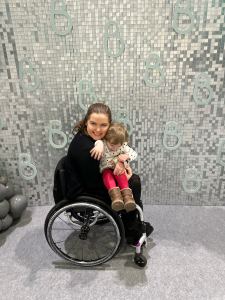
Steph, a white intersex woman with brown hair is wearing a black dress and black cardigan. She is sat in her silver and black wheelchair with Alice, a small white toddler with dark blonde hair wearing a white and black polkadot top and red trousers sat on her lap.

All-time favourites like the buggy test track, baby changing area and baby feeding cafe are back again at The Baby Show. This year, the products in the baby feeding cafe are from Lidl’s Lupilu range, which is excellent as it means you can try out more than just the nappies and wipes that Lidl sell. The pouches at the baby feeding cafe are dairy and soya-free too, which is great if your little one has allergies like Alice! As always, lots of talks are happening across the weekend, so be sure to check your show guide for ones that may be of interest! Toddler Town Company are also at The Baby Show this weekend with their soft play, so be sure to check it out! 

Access wise, The Baby Show London ExCel is, in my opinion, the more accessible of the two locations that The Baby Show London uses across the year (the other being Olympia). There are plenty of ways to get to The Baby Show at ExCel, including by car, where you’ll find plenty of parking! Note that parking is no longer free for blue badge holders at the ExCel!  

If you prefer to avoid driving in London. ExCel is easily reachable by public transport. Not only is The ExCel well served by the DLR and Elizabeth Line, with both Custom House and Prince Regent in easy reach. If you’re coming from central London, take the Jubilee line to North Greenwich and take the Emirates cable car across The Thames for a scenic view of London. If you prefer something else to the tube, take the Uber Boat from central London to North Greenwich for a different view of London. 

Once inside, the ExCel has plenty of accessible toilets and a changing places facility onsite, making it one of the more accessible and inclusive baby shows on the 2024 calendar! 

Brands to Visit: 

My 1st Years (L10)

My 1st Years offer a range of personalised products, including wooden toys, blankets, clothes and more! If you don’t yet know the baby’s name, My 1st Years can personalise the products with their surname instead, still making it a unique gift whilst giving the parents the potential to keep the product for future children. 

Seraphine (E62, F70)

Seraphine was my go-to brand during pregnancy and breast/chestfeeding with Alice and will always have a special place in my heart. When I interviewed for my current day job, it was one of their top and dress sets that I wore as I was still breast/chestfeeding. I also wore it to the in-touch day I had and several times at work when taking Alice in. I also still happen to have all of my Seraphine dresses! 

However, one of the biggest launches happening at the Seraphine stand is the launch of their game-changing Seraphine CARIPOD! As a wheelchair user, this is something I wish was on the market when Alice was first born, as the carrier we were using didn’t feel safe when she got bigger. We tried the Seraphine CARIPOD together on the stand, and I can confidently say I’ve never felt safer with Alice on me, even being able to push around and bring the front castors up whilst testing it out! We’re hoping to be able to do a full review on the Seraphine CARIPOD soon so keep an eye out! 
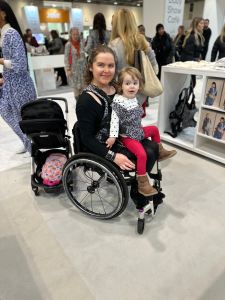
Steph, a white intersex woman with brown hair is wearing a black dress and black cardigan. She is sat in her silver and black wheelchair with Alice, a small white toddler with dark blonde hair wearing a white and black polkadot top and red trousers sat on her lap. Around Alice and Steph is an animal print themed carrier on with all the buckles at the front.

Ella Bella’s (D50)

Ella Bella’s are back at The Baby Show London with their range of baby clothes and accessories! They also have a store in Lakeside featuring more of their range and sizes for toddlers, and we’re looking forward to popping in there when we next go to Lakeside! 

Lidl GB (R31)

Lidl is the main sponsor for The Baby Show, and whilst you can try their products from the Lupilu range in the changing area and baby feeding cafe, they’ve also got bundle offers, money-off vouchers and more at their stand! 

Medela (L19)

With Alice being ex-NICU, Medela has been a brand we’ve used since day one, and it was lovely to catch up with some of the team! I got on so well with the Medela pump in hospital that I ended up buying a swing maxi for home in the days before wearable pumps became more mainstream. Medela now do their own wearing pump called Freestyle, so be sure to pop by! 

Start-Rite (E60)

The proper footwear at the right time is essential for growing feet, and Start-Rite are keen to spread that message with their range of shoes from pre-walkers to those starting school and beyond! They have some of the range on stand so make sure you pop by! 

Luxury Family Hotels (F31)

Luxury Family Hotels are running a giveaway at The Baby Show this year! If you haven’t heard of them, they have a range of family-friendly luxury hotels because who said travel stops when you have kids!? 

Fusion Allergy (G69) 

Hidden under their corporate name of Scope Eye Care in the show guide, which may confuse some, Fusion Allergy is back with their medication-free allergy range, including wipes, eye drops and other products! We’ve picked up a couple of products for both Alice and I to try, so keep an eye out for future reviews!

Lovevery (B50)

If you’re like us and a big fan of wooden toys that aid development and want something that will help you on your Montessori parenting journey, look no further than Lovevery’s subscription boxes! The boxes are appropriate, and Lovevery also offers a service specifically for disabled children or those who need age-adjusted boxes due to prematurity. Alice loved spending time on their stand, and we’ll be looking at the boxes for her! 
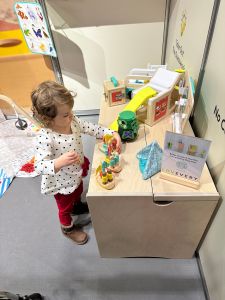
Alice, a small white toddler with dark blonde hair wearing a white and black polkadot top and red trousers stands at a wooden table with several colourful wooden toys on. She is playing with the wooden boats. The photo is taken from above.

Are you off to The Baby Show this weekend? Let us know your favourite moments and brands in the comments! 

This blog post is part of a paid partnership with The Baby Show and its organisers.

Everything You Need To Know About The Baby Show 2023!

It seems like only yesterday that it was the end of The Baby Show at ExCel London 2022. Still, precisely a year later, it’s back and better than ever at ExCel! We’ve been lucky enough to be invited down for the weekend to share the lowdown on what’s what at The Baby Show 2023! 

Getting to the show!

There are plenty of ways to get to The Baby Show at ExCel! New for 2023 is that parking is now free for blue badge holders, so for us taking the car was a no-brainer, especially as the collect-by-car service is back, allowing you to shop until you drop! This is also great for disabled people, as it makes the show that bit more accessible!

If you prefer to avoid driving in London. ExCel is easily reachable by public transport. Not only is The ExCel well served by the DLR and Elizabeth Line, with both Custom House and Prince Regent in easy reach. If you’re coming from central London, take the Jubilee line to North Greenwich and take the Emirates cable car across The Thames for £3 each way (under 5’s free) on the production of tickets or the email to show that you’re going to ExCel London for the event. If you don’t fancy the tube, take the Uber Boat from central London to North Greenwich for a different view of London. 

At The Show!

Once you’re inside The Baby Show, there is much to discover! The Made For Mums testing track is back, so you can try out different pushchairs. In addition, there are various must-visit areas, including the baby changing area sponsored by Lidl, which features free wipes, nappies and other products from their Lupilu range. The baby feeding cafe is back with allergy-friendly baby food samples from For Aisha. I highly suggest trying this brand if your little one is allergic to dairy, soy or egg – Alice loves their meals when I need to throw on something quick! You can pick up a range of samples to take home with you too! The cafe also has a quiet breastfeeding area for more privacy, with rocking chairs and breast pads available! 

Must-Visit Brands!

Nearly all the brands at The Baby Show offer discounts and special show-only bundles, no matter their size. We have used some of the brands personally already, and some we’ve only just discovered at The Baby Show! 

MAM Baby: 

Although Alice is breast/chestfed, we use a range of MAM products, including the soothers (their night range glow in the dark, making finding soothers so much easier in the wee hours) and the bottles when Alice has expressed milk. There are offers and bundles on near enough their entire range! 

Munchkin & Bear: 

We’ve been using our Munchkin & Bear playmats for almost a year after discovering this brand at The Baby Show last year! With me being a wheelchair user, we needed a tough mat that could be easily stored or take a good bashing from the constant rolling over. It also has been a lifesaver when Alice has had seizures at home, as our mats have cushioned many a tumble! In addition, Munchkin & Bear have recently launched a toy range, so Alice has fun picking some toys to take home with her! 

Ella Bella’s: This gorgeous brand came to the rescue when Alice had a sock emergency at The Baby Show last year! It was great to see them back for this year with their range of baby clothes! 

Hotmilk: At almost 19 months, Alice is still breastfeeding, so I still need nursing bras! Hotmilk offers lovely bras from various ranges they’ve created, including a range with magnetic clips. These are great for people like me whose joints mean gripping the classic style clips is almost impossible! I will be purchasing some of the range on the last day (tomorrow!) to review, so do look out for it! 

We’ll be exploring and discussing many more brands on the blog off the back of The Baby Show 2023. Still, if you’re going for the final day on Sunday (Tomorrow at the time of writing this post!), we’ll see you there! 

This blog post is part of a paid partnership with The Baby Show and its organisers. 
World Breast/ChestFeeding Week

World Breast/Chestfeeding week was always going to throw up some emotions, but I (Steph) want to mark it with a reflection of our personal journey and some things I’ve noticed on our breast/chestfeeding journey so far.

I sit here looking back on our breast/chestfeeding journey so far, wondering how I’ve managed nearly 12 months of feeding Alice. Anyone who knows me will know that I’m a massive advocate of breast/chestfeeding. Even before I got pregnant, I knew that as long as it was safe to do so, I’d breastfeed for as long as possible.

Has it been easy? No, and if anything, far from it. I’ve only gotten this far because Alex has been my biggest cheerleader from the get-go. Even when someone tried to give Alice formula after she was born, he made it clear she was being breastfed. Whilst I was pregnant, I had conflicting info to fight, my neuro team at St George’s told me I had to breastfeed or express for a minimum of 6 months or risk Alice going into baclofen withdrawal, whilst others told me it would be impossible due to several factors including my hormone levels (joys of high testosterone!). I’ve had to deal with some pretty unsupportive and frankly awful comments about how I choose to feed Alice, but knowing I’ve got loads of support around me has seen me through those times. Even with my EDS and despite the misinformation around testosterone levels and feeding, we have somehow managed it!

Did you know that WHO recommends exclusive breast/chestfeeding to 6 months and then continuing to feed alongside solids until at least 2 years old!? So that 2 years is something I’m aiming for. But my personal experience of breastfeeding in a country with one of the lowest levels of breastfeeding in the world made me realise why so many don’t do this.

Breast/chestfeeding parents have a massive lack of support. We were extremely fortunate to have had a fantastic team of people around us who supported me in initiating breastfeeding and have continued to be a huge help when the goings got tough. Alice stopped breathing during her first ever feed. Most people would’ve given up at that point. Thankfully, Alex, my dad, the nurses in NICU at Frimley, and several midwives (you all know who you are) sat with me and helped me through those first weeks where every single feed, I was scared Alice would stop breathing again. Our health visitor has been nothing but incredible, too (I know HV’s; I usually get the stick, so we’ve been lucky!).

The NHS pushes the ‘breast is best’ mantra but doesn’t offer support when needed most. Lactation consultants are either very expensive or not in your area (tip: find a breastfeeding hub, there are a few in NE Hampshire/Surrey that I know of and have personally used who have some fantastic counsellors!). Additionally, god forbid the breast/chestfeeding parent needs to go to the hospital – I’ve personally had to refuse to be admitted because the hospital wouldn’t let Alice be fed on the ward after letting me feed her in a&e with no issues! And don’t get me started on the lack of services for disabled parents/LGBTQIA+ parents etc.!

If there could be some positive things that come from World Breastfeeding Week, it would be for there to be more support for those who want to breast/chest feed their little ones, and for the NHS to offer lactation consultants/information and support on expressing/pumping for all parents (not just those in NICU), SNS feeding options etc. rather than making parents feel like a total failure and forcing them onto formula! Even better would be for the NHS to start supporting non-birthing parents who want to initiate breast/chestfeeding – it can and has been done!

a selfie of Steph, a white female with light brown hair wearing a back top with Alice on her feeding in the bottom left corner.

Our First Pride Month As Parents

As Pride Month draws to a close, let this first be a reminder that we, the LGBTQIA+ community, exist. We always have, and we always will. Secondly, let this also be a reminder that active allyship matters year-round and not just for the month of June. Disgustingly, but not surprisingly, too many companies rainbow wash their western social media accounts and physical premises whilst doing nothing to support the LGBTQIA+ community in parts of the world where simply living life as your authentic self could get you imprisoned or, worse still, killed.

Last Pride month, we were patiently awaiting our little baby’s arrival. This Pride month has been our first as parents. Looking back, it’s interesting to see how being parents has slightly changed how we mark Pride Month. For us, Pride has, and always will be, a protest. Our rights are still being attacked, our right to live, our right to be our authentic selves. So this month, we’ve been looking at who shows active allyship year-round and who is only doing it for June (not cool, in case you’re wondering).

We’ve also been getting Alice involved in seeing some of the various installations near us, and with Pride In London being this weekend, we are excited to be taking her on her first Pride parade with friends from football (look out for the Chelsea Pride bus!). Alice might still be a baby, but for us, getting her involved and giving her the understanding of why Pride is needed, the history and the work that is still yet to be complete is super important to us as members of the LGBTQIA+ community. Just like no child is born racist, no child is born homophobic, biphobic, transphobic or interphobic. Children learn from the environment that they’re brought up in, so bringing Alice up around diversity, inclusion, and equality is a must.

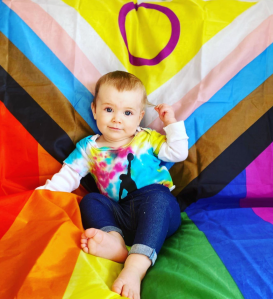
Another thing we’re planning to do with Alice is to take a photo of her each June for Pride with the Intersex-Inclusive Progress Pride Flag, which was designed last year by the wonderful Valentino Vecchietti. With Alex being trans and me (Steph) being intersex, this flag really does represent us. All too often, the trans and intersex communities are forgotten about when people talk about issues the LGBTQIA+ community face, so to see both of our community’s flags on the new design gives us some hope for the future that people will be more inclusive in their language and conversations. Alice will grow up to be a very active ally at the very least, so it will be great to be able to show her how she’s growing up around Pride and how we mark it each year. If you haven’t guessed already, Alex and I are very sentimental and prefer to take photos and videos to capture experiences rather than buying things which will only cause clutter. However, there are some things we’ve brought to show Alice when she’s older, including our friend AJ Silver’s book, Supporting Queer Birth, for which I was very honoured to be interviewed whilst pregnant with Alice. Being able to share my lived experience as an intersex person who has had many dealings with perinatal care (both negative and positive) is so important because we’re very rarely heard. It’s also why Alex and I were honoured to be part of The Positive Birth Company’s #ProudParent campaign last year.

Well, that’s how we’ve marked Pride month; quieter than we originally planned for various reasons, but as we always say – Pride is every day and not just for June! Allies show up every day of the year, call people out and pull them up on their language and behaviour when needed. So don’t let comments slide. We should be well past that now!

Finally, one last thing. This year’s world cup is being played in a country where it is illegal to simply be your authentic self if you’re LGBTQIA+, and that’s just the tip of the iceberg since Qatar abuse numerous human rights. So remember that when you see FIFA promoting equality, inclusion and diversity because if they genuinely cared, the world cup wouldn’t be held in a place where it is so unsafe for so many people.

Alice, a white baby with brown hair is wearing a rainbow coloured vest with white long sleeved vest underneath and dark blue jeans. She is sat on an Intersex-Inclusive Pride flag and holding her hair in one of her hands.
Alice sitting on her Intersex-Inclusive Pride Flag

The Lowdown On Baby Show London 2022

I can’t believe we’re actually saying this, but The Baby Show is finally back as an actual event in London this weekend at ExCel! No longer are we tuning into virtual talks from the comfort of home, as we can now try out products once again for ourselves before committing to buy! With Alex flying today, my dad came with Alice and me for the trip to London so we could give you the lowdown on what to expect at The Baby Show this weekend. 

Getting to the show: 

The best way to The Baby Show is by public transport. Not only is The ExCel well served by the DLR, with both Custom House and Prince Regent in easy reach. If you’re coming from central London, take the Jubilee line to North Greenwich and take the Emirates cable car across The Thames for £3 each way (under 5’s free) on the production of tickets or the email to show that you’re going to ExCel London for the event. If you don’t fancy the tube, take the Uber Boat from central London to North Greenwich instead for a different view of London. It’s incredible to compare the sights from the river and then the cable car either before or after, and Alice loved her first boat ride! 

Steph, a white woman with her brown and blonde hair in a ponytail is sat down wearing a blue jumper whilst holding Alice, a white baby with brown hair who is wearing a cream pram suit who is fascinated by the view. They are on the cable car going across the Thames!
On the cable car!

If you do need to drive in, the ExCel has plenty of car parking, and you can even drop your bags and pick them up when ready to leave. However you decide to travel, don’t forget to download your COVID pass before you make your way to the show, as you’ll need this to gain entry. 

At The Show

Once you’re inside The Baby Show, there is a lot to discover! The Made For Mums testing track is back, so you can try out different pushchairs. In addition, there are various other must-visit areas, including the baby changing area sponsored by Lidl, which features free wipes, nappies and other products from their Lupilu range. There’s also the baby feeding cafe with baby food samples from For Aisha. If your little one is allergic to dairy, soy or egg, I highly suggest trying this brand. You can pick up a range of samples to take home with you too! We will be trying out this brand with Alice, so keep an eye out on our Instagram to see how we get on. For Aisha are also running a competition on their stand, which can be found at C50! The cafe also has a quiet breastfeeding area for more privacy. 

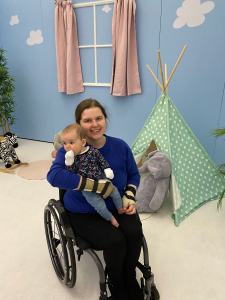
Steph, a white woman with her brown and blonde hair in a ponytail is sat in her wheelchair wearing a blue jumper, black trousers and hand splints whilst holding Alice, a white baby with brown hair who is wearing a dark blue floral top with light blue jeans. Behind them is a green tent with a large grey cuddly toy by it. Behind on the wall is a false window with pink curtains.
Inside the changing area
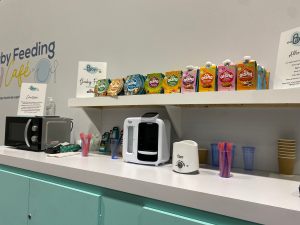
A photo of a baby foodprep area with microwave, prep machine, bottle warmer and cups with pink and purple spoons in. Above is a shelf with various coloured bowls and pouches containing meals for babies.
Baby feeding cafe featuring For Aisha meals and pouches!

Must-Visit Brands

Nearly all of the brands at The Baby Show are offering discounts and doing special show only bundles no matter their size. We have used some of the brands personally already, and some we’ve only just discovered at The Baby Show, but we will be ordering if we haven’t already brought from those brands. 

MAM Baby (B72): 

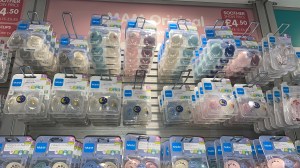
Although Alice is breast/chestfed, we use a range of MAM products, including the soothers (their night range glow in the dark, making finding soothers so much easier in the wee hours) and the bottles when Alice has expressed milk. There are some fantastic show offers, including soothers from £4.50, Bottle accessories from £4.50 and huge savings on pumps. MAM is also offering 1 to 1 appointments with their experts at the show. 

Photo of various MAM soothers and dummy clips on their stand.
Soothers on the MAM Baby stand

Muchkin & Bear (C44): 

We’ve been looking at playmats for a few weeks now as Alice is starting the outgrow the play gym. Being a wheelchair user, we need a tough mat that can be easily stored or take a good bashing from the constant rolling over and, of course, is suitable for Alice! We got to try the large mat at the show, and Alice absolutely adored it. We just need to decide which colour combination we want (the mats are doubled sided), and then we’ll be ordering over the weekend! 

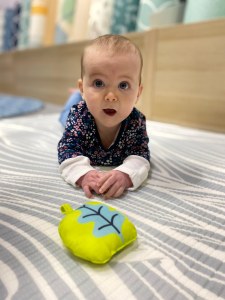
Alice, a white baby with brown hair wearing a dark blue long sleeved top with floral patterning on is laying on her tummy whilst holing her head up on a grey and cream striped play mat. In front of Alice is a bright green toy with a blue tree on.
Play time!

Snuz (E20, E50, E60, E80): If you have followed us for a while, then you’ll know Alice sleeps in a SnuzPod co-sleeper, and we use the Snuz Pouch and other products in the Snuz range. There are some fantastic offers over the show, including bundles with the SnuzPod.  

Ella Bella’s C41: When Alice had a sock emergency, this gorgeous brand came to the rescue! Not only did we leave with a pair of adorable socks with pom-poms on (they also do bow styles), we also picked up some booties that can tighten, making it more difficult for little ones to kick them off! 

photo of Alice, a white baby with brown hair who is wearing a dark blue floral top with light blue jeans and white socks with pom poms on being held by a person wearing a black leather jacket. They are on the cable car.
Alice showing off the pom pom socks!

Mima Accessories (B11): While Alice doesn’t like to keep headbands on (hence why we don’t have an extensive collection), that hasn’t stopped us from starting a hair accessories collection! We picked up 3 bows from their 3 for £5 bowl, and there are also other various offers on accessories from the brand. Mima Accessories happens to be the newest range from Mima Interiors, and products from the interiors range can also be found on their stand at The Baby Show. 

Cybex (E20, E50, E60, E80): Cybex again is a brand we’ve used from birth as Alice happens to have two of their infant carriers. Both the Aton m I-Size and Cloud Z I-Size infant carriers fit onto the Bugaboo Cameleon 3 pushchair for convenience via adapters. The L.S.P. side impact system on the car seats is also a big plus as it enhances little ones’ safety in the car. However, one feature that the Cloud z has over the Aton M is that it can lay flat in pram mode, something to consider if you’re likely to be doing many short trips using Uber or taxis. 

The Positive Birth Company (C39): Whilst we didn’t find out these lovelies were at the show until after we left, we had to give them a shoutout once we knew that they are indeed at The Baby Show this weekend! We were honoured to be part of their #ProudParent campaign last year, and the courses that The Positive Birth company offer are second to none! The Positive Birth Company also have an Amazon Alexa skill which I loved using during my pregnancy to relax and keep the positive vibes going when the going got tough! 

Some brands sadly aren’t at The Baby Show this time around. Bugaboo and Ergobaby are the two biggest ones that people will miss from the show. We use products from both of these brands, and they have features on some products which are extremely useful for disabled parents. It’s sad to not see them there, but hopefully, they’ll be back in the future! 

Are you going to The Baby Show this weekend? Share your favourite moments, brands and tips with others in the comments! 

Why Children Need To Learn About LGBTQ+ History

With LGBT History Month almost over, we’ve only just realised that we didn’t do a blog post. However, that doesn’t mean we haven’t been doing anything in real life since we decided that we’d use this month to do a bit of learning ourselves. In particular, we wanted to know more about our ancestors and the fight they had to give us the freedoms which the LGBTQIA+ community has today, to help us in our fight to make the world a safer place for our community as a whole, especially as 71 countries still criminalise same-sex relationships with 11 of those imposing the death penalty and it doesn’t stop there. In 2022, it’s illegal to be transgender in 15 countries. Those numbers are a stark reminder of how lucky we are in the UK that, at least legally, we can be our authentic selves.

However, it doesn’t end there. Just because it’s legal to be who you are, doesn’t necessarily mean safety. As the community knows, attacks against LGBTQIA+ people are heartbreakingly on the rise again, with homophobic hate crimes tripling and transphobic hate crime quadrupling in the UK since 2015. Those stats are scary, especially being LGBTQIA+ and parents. As a community, we’re still feeling the effects of section 28, despite it being repelled in 2003, and it wasn’t until 2020 that schools in the UK were required to teach pupils about LGBTQ+ relationships and identities.

Children need to be brought up to respect, include and accept. People say that no one is born racist, which is true. It’s also true that no one is born homophobic, biphobic, transphobic or interphobic. However, what is heard at home spills out, so it’s vital for parents and carers to teach children to accept and respect others, no matter their differences so that the generations that follow us don’t have to experience the hatred that many LGBTQIA+ people have. Therefore, children need to learn about the history of the LGBTQIA+ community, and there is a wealth of information and resources at parents’ fingertips.

Even though Alice is only 6 months, we’ve started to teach about differences already by using reading time with age-appropriate books. For example, Books like Aaaarrgghh! spider! and Perfectly Norman celebrate differences and teach children to accept each other’s differences no matter what they may be, whilst Super Duper You also challenges gender stereotypes at the same time. When exploring different families, Love Makes a Family is an excellent book to show children that families come in many shapes and forms and that some children have two mums or two dads, one parent or one of each.

Of course, you can also introduce the conversation around differences through play. For example, using they/them pronouns for characters to help children learn about non-binary identities and present different types of families when playing with dolls or character-based games. This will help children learn about inclusion and acceptance and the need to respect all people without even realising it. For older children, many video games are introducing LGBTQIA+ characters into their lineup. There’s also plenty of content out there, from content creators on YouTube to films and documentaries on various streaming platforms. So, as you can see, whatever way you wish to introduce new topics and conversations to your children, there are plenty of resources out there to support your and your child/rens learning. By introducing these conversations, you’re then building the foundation for children to learn about the history of the LGBTQIA+ community, which is essential for children to understand why acceptance and respect for others are so important.

Have you found any good films, videos, books or other resources to help teach your children about acceptance of others? Share them below to help others!

This post contains affiliate links. This means that we receive a percentage of the revenue made from purchasing products when you click on a link. This does not affect you as the consumer or the price of the product or service. It is also not a paid for promotion or a collaboration/advert.

Going To Big Events With A Newborn

For some parents of newborns, there will be events that you wish to attend but are worried about taking your new bundle of joy with you. Whether it be a summer fair or a big event for your town or city, a fireworks display or a Christmas light switch on, attending with a brand new baby in tow means lots more things to think about! Big events typically mean lots of noise and lots of things going on, which can be overwhelming for your little one! 

Despite many stressful events surrounding Alice’s health, we have still managed to get out and about with her. Alex and I crave normality and for us, going out and about to our favourite events gives us that little bit of much-needed normality in what has been a stressful couple of months. But how do you safely take your precious bundle of joy to significant events and on busy days out? Well, here we share products and tips that have really helped us! 

1. A suitable baby carrier

Alice has two baby carriers, one which I use with her when out and about, and the other one is Alex’s favourite. For me, the Ergobaby Omni 360 is the best baby carrier for many reasons. Firstly, as the carrier is structured, I can safely carry Alice despite being a wheelchair user without risking any dislocations. Secondly, the pouch on the front of the carrier is large enough to put cards, passports, phones and other small but essential things in there and keep them on me. Not only is this excellent safety-wise, but it’s also an excellent feature for when travelling and at large events. For example, I used the Ergobaby when taking Alice to her first football match. In addition, the carrier is easy to get babies in and out of. This meant that Alice had lots of time out of the Ergobaby that day! 

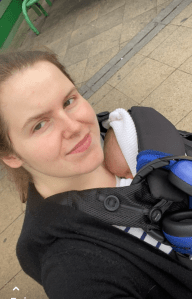
a selfie Steph, a white woman with brown and blonde hair wearing a black baby carrier with Alice, a small baby with brown hair and wearing a white jacket inside. The baby carrier has blue and blue ear defenders and a blue Chelsea bib attached to it.
Alice in the Ergobaby!

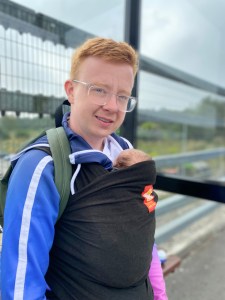
Whilst I absolutely adore the Ergobaby, Alex loves the wrap-style carriers, so we also have the Hana Baby Wrap, which he uses with Alice when we’re out and about. However, he is going to try the Ergobaby later this month when we go to London! The wrap style is great as it can be used with smaller babies subject to clearance from a medical professional. It also allows little ones to be held in many different positions and closer to whoever is wearing them. However, I found that as a wheelchair user, the wrap style isn’t that safe until little ones can hold their head up, which is why Alice is carried by Alex a lot more than by me! 

Alex, a white man with red hair and wearing glasses is looking towards the camera smiling. Alex is wearing a blue and pink jacket, and a black baby wrap which has Alice, a small white baby with brown hair inside.
Alex carrying Alice in the Hana baby wrap

2. Good ear and eye protection! 

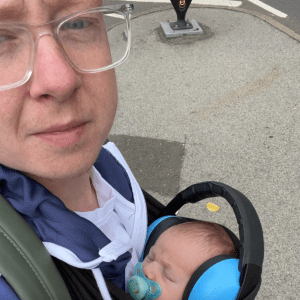
Tiny ears and eyes are extra-sensitive. A baby’s hearing can easily be damaged by loud noises and speakers if too close. For us, getting Alice not one but two pairs of Banz Baby ear defenders was a no-brainer. Having two pairs means we can keep a pair at Alex’s and a pair at mine, which means no worrying about losing ear defenders and having no backup, or worse, leaving them at the one house when going to an event from the other! True story; Alex didn’t know about the second pair until I took Alice with my dad to her first Chelsea match! He was panicking about her having no ear defenders until I sent a photo of her second pair attached to the carrier, ready for when we got to Kingsmeadow! 

A selfie of Alex, a white man with red hair wearing clear framed glasses carrying Alice, a white baby with brown hair wearing light blue and black ear defenders.
Alice rocking one of her pairs of ear defenders!

As for eyes, sunlight can damage little eyes, and it can be hard to find suitable sunglasses for babies. Luckily, Banz Baby also have a selection of matching sunglasses to go alongside their ear defenders! The sunglasses fit around the head using an adjustable headband, and both the ear defenders and sunglasses can be used until the little one is around 2 years old before needing to move up to the next size. 

3. A good changing backpack

I have raved about this changing backpack in a previous post, but it really is excellent for days out, going to large events, travelling and just as your usual day-to-day changing bag. Not only does this particular bag from Amazon have a big main compartment for a change of clothes, snacks etc. It also has a bottle pocket that can store three bottles, a phone charging port (need your own battery pack) and a pocket for baby wipes! The most significant function for me, however, is the inbuilt cot and changing mat. Not only does it mean you can change your little one with privacy, but they can also nap in it when out and about during the day if at a picnic, for example. The cot also features a sun canopy for protection on sunnier days or as a barrier against the wind when using it when outside. It’s important to note that the inbuilt cot isn’t suitable for overnight sleeping, however, so you’d still need a travel cot if going away. 

Overall, large events can be done with a bit of planning and organisation beforehand. However, having a baby doesn’t mean life has to stop! You can very much still have a life and attend events like Christmas light switch on, Pride, picnics, fun days etc., with your bundle of joy! 

Do you have any tips to help new parents who want to go to events with their little ones? Then, share them in the comments! 

This post contains affiliate links. This means that we receive a percentage of the revenue made from purchasing products when you click on a link. This does not affect you as the consumer or the price of the product or service. It is also not a paid-for promotion or a collaboration/advert.

Meet Our Little One!

TW: This post details our NICU journey and the reason why our baby needed NICU. 

Following on from our birth story blog posts, it’s time to introduce our little one to you all, as well as what happened next! 

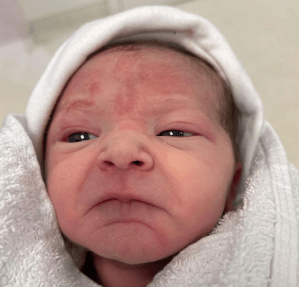
Our little miracle and fighter, Alice Frances Margaret, was born at 0710 on 21st August 2021, weighing 2480g. She came into the world face up, which meant the first of Alice’s many facial expressions we were greeted with was her extremely grumpy one which Alex managed to get a photo of. 

Alice, a small white baby with brown hair is wrapped in a white towel and wearing a white hat. Alice has various bruises from the forceps on her face and is extremely grumpy!
Alice at 23 minutes old!

Perfect in every way, I was so glad to get some skin to skin with her. However, my right arm had been severely affected by the epidural, which meant I couldn’t lift my arm or move it very well, so Alex and Paige, the midwife who took over from Sarah shortly after Alice was born, had to help me with holding her. All was going perfectly until 79 minutes after Alice’s birth. 

People always say expect the unexpected, but what happened at 0829 on that Friday, just 79 minutes after Alice’s birth, shook both Alex and me to our cores. It really was the worst moment of our lives so far, as Alice stopped breathing while on my chest, and we didn’t even realise it. I genuinely thought that Alice had fallen asleep on my chest. Even when I mentioned it to the nurse looking after us in recovery in search of reassurance, the fact that she didn’t respond made us both think it was ok. It wasn’t until Paige came back in 30 seconds later and realised what had really happened that all hell broke loose. 

Having your baby swiftly taken off of you and seeing medical staff resuscitate them whilst the emergency buzzer means more medical staff are swarming into help is something that neither of us would wish on our worst enemy. I honestly thought we’d lost our baby, and Alex was that focused on trying to see what was being done to Alice that one of the staff had to try and force him to come and comfort me as I was being pushed out of the bay to a different area of recovery. We had no idea at that moment in time if our baby would make it. The 15 minutes it took to find out the update was the longest 15 minutes of my life. It truly felt like hours. 

The doctor who came to give us the initial update on Alice happened to be one of the doctors who looked after my mum in 2013 when she was fighting for her life in ICU. The second he said Alice was breathing, I felt the most enormous wash of relief pour over me. It didn’t matter that they were still trying to stabilise her and that the neonatal team were transferring her to NICU at that point, she was alive, and that was all that mattered. 

Shortly after the initial update, I was transferred back to the labour ward, and Alex came with me. At this point, I was trying to process exactly what had just happened to us, but if I’m honest, my brain couldn’t take anything in. As soon as I saw my dad and he realised that Alice wasn’t with us, I burst into tears once more because I couldn’t get out exactly what happened and Alex had to tell him for me. It would be another 24 hours before my dad met his first grandchild, as our NICU had a rule that grandparents could only visit on weekends in the afternoon due to covid. Still, it was a lot more lenient than most NICUs in the UK. At the time of writing this blog post, some weren’t even allowing parents to visit their child/ren together. 

Soon we received another update from the doctors working on Alice, and with them came the news that our baby was finally stable but not yet out of the woods. One of us was allowed to go and see her, but I couldn’t push myself in my wheelchair, so I told Alex to go down and get lots of photos and videos for me until I could go myself. As upset as I was that we weren’t going together, I knew that Alex would be able to prepare me for when I finally got to see Alice. After Alex got back, we were moved to postnatal, so I sent dad home to get some rest before bringing the colostrum we’d harvested to the hospital. I was an absolute hot mess, so before going to neonatal myself to check up on Alice, Alex helped me get showered and changed. He then briefed me on all the rules and what to expect, but if I’m honest, nothing could have prepared me for what I was about to be wheeled into. 

Having a baby in NICU is something I wouldn’t wish on my worst enemy. Seeing your child so unwell and not being able to hold them is tough. Once Alex wheeled me down, and we’d both washed our hands, he took me over to Alice. She looked so unhappy, which make me shed tears once more. She was covered in wires, hooked up on oxygen and on fluids. Her incubator felt like this massive barrier; I couldn’t hold her or do skin-to-skin to comfort her. It was a far cry from how everyone expects the first few hours after giving birth to go. Thankfully, one of the nurses came over to ask if I wanted to put my hand in and comfort her that way, which I jumped at the chance to do. I felt awful for Alex, who couldn’t hold or touch Alice the entire time she was in NICU. It wasn’t until Sunday, when Alice was on transitional care, that he got to hold her for the first time since she’d stopped breathing 2 days earlier. On the other hand, I got my first cuddle on Friday night whilst being able to feed her. However, it was filled with anxiety as the position I had her in for feeding was the same position she was in when she’d stopped breathing 12 hours before. 

Alice, a small white baby with brown hair is laying on a pastel yellow and pink coloured patterned mat in an incubator. She is wearing a nappy as has oxygen prongs in her nose, a cannula on her right hand and various wires over her body. She looks very grumpy!
Alice in NICU

Although Alice was out of NICU after 40 hours, followed by 2 days on transitional care before going home, those 40 hours taught me so much about a world few know about. Being NICU parents really showed Alex and me just how strong we are, even if we doubted that strength before. Before going home, we managed to catch up with Paige, the midwife who literally saved Alice’s life and between her and the neonatal doctors got as much information as we could. Unfortunately, not all the questions were answered; we’ll never know the reason why Alice stopped breathing. The fact she did in the first place shocked even the team looking after us, especially as Alice had an Apgar score of 9 just 1 minute after birth and then a perfect 10 at 5 minutes. A few have asked us if my Group B Strep infection caused it or if the reduced fetal movements played a part, which again is something we’ll never know. However, although we were fully covered with antibiotics for Group B Strep, Alice’s infection markers were raised when checked, so she was placed on IV antibiotics for a few days as a precaution. Since we’ll never know what caused her to stop breathing, we have been warned it could happen again. It’s something I constantly hope doesn’t happen, but if it does, Alex and I both know how to resuscitate babies and infants thanks to work. 

September is NICU Awareness Month, and we’re so proud of our little fighter who made it through. We’re forever thankful to all the staff who worked on Alice and got her well enough to come home as quickly as she did. We’re also grateful for the support of Bliss, a charity here in the UK that provides information and support to parents of babies born premature or sick, as well as research into improving care and treatment.

Alice, a small white baby with brown hair is wearing a white vest and laying on her back with her head turned to the side in her snuzpod, which has a white sheet with grey stars on the mattress. There is a grey blanket covering Alice and she is asleep.
Alice Now!

Our Birth Story: Part One – Induction

Finally, the time has come for us to share our baby’s birth story! After our baby was born on 20th August 2021, we thought it would be nice to share our birth story and what happened. As it’s pretty lengthy, we’ve split it into two parts – induction up to labour in part one and labour/birth in part two. We hope that sharing our story will help those of you who are giving birth in similar circumstances.

Wednesday 18th August 2021

After nearly three weeks of being in hospital (bar home leave to sort out the last few bits between CTG monitorings), the day had finally arrived to induce labour and meet our little miracle. Although this date had been the planned date for the last four weeks of my pregnancy, getting there wasn’t guaranteed, especially after finding out about the fetal growth restriction and the low baseline heart rate that would often get picked up on overnight CTG monitorings. 

At 0830, the midwives who we’d gotten to know very well in the final few weeks came to transfer us over to the delivery suite. Unlike most people who have their inductions started on the antenatal ward, my consultant wanted me on delivery suite to keep a closer eye on me because of my risk factors. We were fortunate that because everything had been well planned out in the weeks leading up to induction day, we had the largest room in delivery suite, which is usually reserved for multiple births. It meant that I had room to move around in my wheelchair, even with all of our bits and pieces. 

A few minutes after arriving in our room, my consultant and the team on the delivery suite with her that day came to say hello, discuss the plan and see if we had any questions. After we discussed the plan and exchanged a few jokes about the size of my suitcase (a great mood lightener which helped put my nervousness at ease), we were left to get settled in. About an hour later, the midwife looking after me for the day came in to examine me and start the induction! 

As my cervix wasn’t entirely favourable, our induction was started with a Propess pessary which was left in for 24 hours. Alex and I spent the rest of Wednesday morning watching Netflix. Later in the day, dad arrived, so we decided to go outside and get some much-needed fresh air before they went home.

Thursday 19th August

At around 0330 on Thursday, the contractions I’d been having for weeks beforehand were finally strong enough to trigger my headaches. The problem with this, however, was that my blood pressure also became spiked. Thankfully paracetamol took the edge off a bit for a couple of hours until it stopped doing anything. 

Come 0900, the contractions were getting stronger but still not regular. The team looking after us for Thursday came to introduce themselves and discuss seeing if the Propess had done anything. At 1030 we had another monitoring done before the pessary was removed. Although it had softened my cervix, we still weren’t in a position for my waters to be broken, so it was time to try the gel! The gel went in around 1100, meaning we’d be checked at 1700 to check progress. 

By lunchtime, the headaches had really ramped up, and nothing was working. Alex had to help me transfer when I needed to catheterise as the pain was triggering my spasms and making transfers nearly impossible. Eventually, at around 1500, the team asked me if I wanted to try an epidural and set the wheels in motion to get it set up. Anaesthetics were called to discuss when to start it. As my waters hadn’t been broken, they were worried it may be in for too long if they were to do it at that point, so instead, they inserted a cannula to try and push IV paracetamol through in an attempt to take the edge off. Unfortunately, due to poor veins on my right side, it took the anaesthetist 3 tries to get the cannula sited. 

1700 soon came, and it was time to check my progress. Alex had gone home for a few hours around 1600 and joked that it looked like I’d peed myself; knowing that it would take a lot of retention for that to happen, I told him that was highly unlikely. Well, you can guess what it actually was that Alex saw – my waters! Somewhere between 1500 and 1700, they’d decided to go on their own. This was great news in that my epidural could be started. However, it also meant my IV antibiotics needed to be started as well. The team of midwives I’m under for my care were called, and Sarah arrived soon after. 

Sarah jumped into action when realising my antibiotics to cover us for the Group B Strep infection I was found to have hadn’t been started. It turned out that most of the team on the labour ward that day hadn’t realised I’m Group B Strep positive on top of all the other things they needed to know about me, so Sarah made sure they were brought up to speed. Around this time, the anaesthetics team came to put in the epidural, which thankfully went in without too much trouble, providing much-needed relief from the headaches. 

Alex arrived back just after the epidural was sited, and then it was time to get the oxytocin drip in that would make contractions more regular! The drip was started around 2130, and at this point, my cervix was still very much closed, so we knew it would be a slog – or so we thought! 

Fast forward to midnight and another check, we were still closed. But at 0300 on the 20th August 2021, the unexpected happened. We were 4cm dilated and officially in labour! 

Find out tomorrow in part two for what happened during labour and birth! 

Our High Risk Pregnancy So Far: Why We’ve Accepted Induction Of Labour

The last few weeks have been stressful with no news and, as a result, no plan. Finally, at 36 weeks, we now have one, but it might not be the plan everyone was expecting us to have. If you haven’t read our previous post about our pregnancy journey so far, you can read the last one here

From the start, we always knew that I’d require some sort of medical input when it came to labour time and birth. Our biggest fears were that I’d be pressured into accepting a c-section which for me would mean a difficult recovery and relying on Alex and our families for almost everything for the first 8-12 weeks, both in terms of my care and little one’s. I’ve always been for a physiological birth, or as close to it as I can possibly get, only going for a c-section or other interventions if absolutely necessary, especially as it would very likely need to be done under general. Luckily, the result of the MDT meeting was that if I don’t want an elective c-section, then I don’t have to have one, but it’s under the condition that I’m aware we could still be heading down that route if either little one or I don’t cope well in during labour. 

How the option of induction came about and why we accepted

One of the biggest things about not going down the c-section route is unpredictability and the risks involved. For us, not only do I have a medical condition which means I can’t feel movements or contractions and have to palpate for them, but I’m also at risk of precipitous labour. Then, to top it off, we found out that I have Group B Strep at 26 weeks, and I’m also at risk of other complications. It meant that the idea of induction was proposed to us, with all the risks and benefits involved. Benefits? We’d have an idea of when my labour will begin, and with it, the option to ensure Alex is off work for a few days so that he doesn’t miss the birth. It also eliminates the risk of me giving birth at home with no help other than Alex’s Avmed training, which, whilst the scope of what Avmed covers is fantastic, where childbirth is concerned, it doesn’t equip you for a complicated labour birth. Cons? If it fails or something else happens, it’s a c-section since assisted delivery via forceps or ventose is out of the question due to dislocation risk. It also further increases my haemorrhage risk, something my consultant already factored in early on so that there’ll be medication drawn up and on standby if it’s needed. 

As my midwife talked to me about induction some weeks ago when Alex’s roster and being back at work was causing me stress around whether or not he’d even make the birth, Alex and I had actually spoken about the possibility of induction. We researched the risks and benefits before my consultant had even offered it to us to come to a decision together without feeling pressured. After those discussions with Alex and my midwife, I said that if induction was offered to me, I’d accept it to reduce the risk of that happening as him not being at the birth would be heartbreaking for us both. It also gives us some control over the situation as long as little one stays put and I don’t go into labour before induction day, something which could happen and my consultant warned us about when we accepted the offer. Alex had already made it clear that he’s scared of waking up during the night to find me still asleep whilst in advanced labour, something which we both know would affect him massively even with all of the training he’s equipped with, thanks to him being crew! 

As you can see, accepting an induction of labour was an easy decision for us once we’d weighed up all of the risks and benefits. Even with the risk of having to go down the c-section route if something goes wrong, the thought of having an unattended labour and birth with all of the dangers attached due to my complex medical history scares Alex and I more. We are also fortunate that we never felt pressured by the team looking after us to accept induction, mainly because we’d had that discussion ourselves beforehand, giving us time to fully consider everything. Not only is there information on induction of labour available to read in my handheld notes, but we also turned to Google to research the specific risks that are unique to our situation and spoke to other pregnant people who have EDS. But what if you’re enjoying a lower risk pregnancy and offered induction, or just don’t know if you want one?

Research is your best friend

Alex and I both know people who have been offered induction of labour and felt little pressure to accept, as well as plenty of people with low-risk pregnancies who felt forced into accepting an induction to keep their team happy. We started looking into our options quite early on once our consultant told me that she’d do everything possible to keep our options for labour and mode of delivery open. That kind of support from her when every other specialist outside of obstetrics had told me that c-section was the safest way forward meant the world to both of us. It also meant that we felt even more supported by the teams looking after us, both at our local hospital and the Silver Start Unit in Oxford, who we’re so thankful to have the specialist input of. 

Great places to research induction include Google (especially as you can tailor your search to your unique situation) and your handheld notes if your hospital provides information on induction of labour in these. I also highly recommend speaking to people who’ve had an induction of labour offered about their experiences, even if they didn’t accept the offer, as firsthand experiences can often help the decision making process. This same piece of advice goes for those who have medical conditions which could influence management. There are plenty of online groups on Facebook etc., which allow you to connect with others going through similar! If you can, start researching and discussing your thoughts with someone else early! This means by the time an offer of induction is given to you (if it is), you’ll have already thought about it and either decided on whether or not to accept, or you’ll have an idea of what questions to ask. It also means that whatever your decision is, you’ll be able to explain the reasoning behind your decision to whoever is looking after you knowing that you’ve given yourself time to consider all the risks and benefits. I’ve also learned to use one acronym that has helped us massively with each decision we make, called B.R.A.I.N. 

What is B.R.A.I.N?

B.R.A.I.N really is what it says it is; it’s using your brain to make an informed decision. 

B – Benefits (what are the benefits of this test or procedure for me and my baby?) 

R – Risks (what are the risks of this test or procedure for me and my baby?)

A – Alternatives (What, if any, are the alternatives?) 

I – Instinct (What is my instinct telling me? What do I think and feel about this test or procedure? Who else can I ask about it?)

N – Nothing (What could happen if I decide to do nothing or wait and see? Can this test or procedure be delayed? Can I take some time to think about it or research?)

B.R.A.I.N is something we’ve used throughout our pregnancy journey to make informed decisions and choices that we know are right for us without feeling pressured into doing something we may not necessarily want to do. It’s also something that we will continue to use and advocate that others use, especially as it is such a handy tool to have. With the NICE draft guidelines meaning that an increasing amount of people are already being offered induction at 39 weeks even if there isn’t a clear clinical need, now more than ever, birthing people and their partners must be able to make informed decisions without feeling pressured into accepting something they may not actually want. 

Have you been offered an induction of labour or had one in the past? Feel free to share your experiences in the comments with us!